
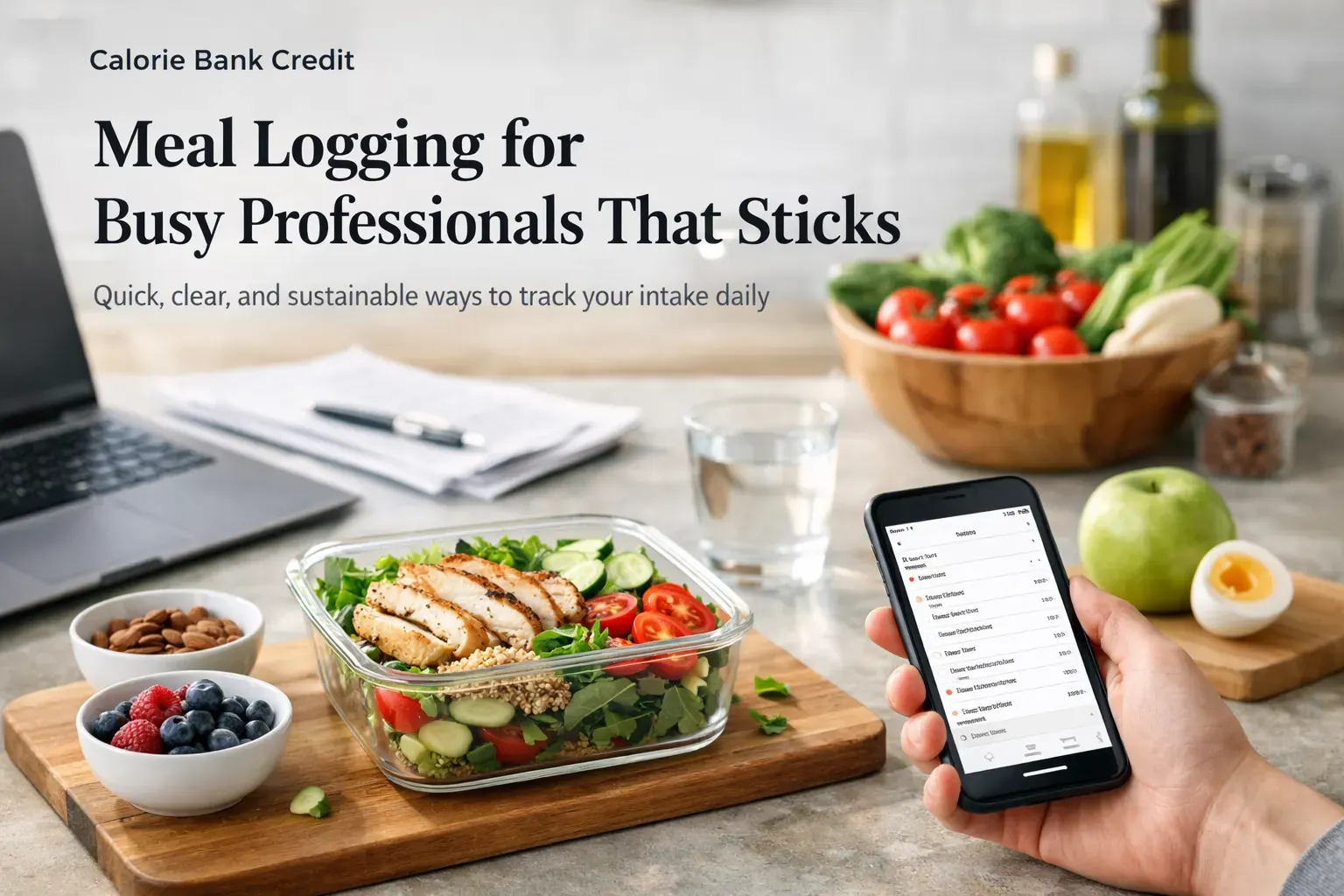
Your 8:30 turns into 9:10, lunch happens at your desk, and by the time dinner arrives you are making food choices on low battery. That is exactly why meal logging for busy professionals needs to be fast enough to survive a real working day, not just a perfectly planned one.
Most people do not stop tracking because they lack motivation. They stop because the process feels like admin. Search for every ingredient, estimate every portion, correct every mistake, and suddenly a useful habit starts competing with meetings, commuting and basic life maintenance. If logging feels slow, it gets skipped. If it gets skipped often enough, progress becomes guesswork.
The fix is not more discipline. It is less friction.
Why meal logging for busy professionals often fails
A lot of calorie tracking advice is built for people with spare time, predictable meal routines and a high tolerance for detail. Busy professionals usually have none of the three. Breakfast is rushed, lunch is improvised, and dinner may depend on what is left in the fridge or what arrives in a takeaway bag.
That makes perfect logging a bad goal. The better goal is reliable logging. There is a difference. Perfect logging means capturing every gram with laboratory precision. Reliable logging means recording enough, often enough, to make good decisions across the week.
This shift matters because body weight responds to patterns, not one heroic Tuesday. If you can keep a clear record of what you are spending, even with the occasional estimate, you are in control. If you only log on your most organised days, you are not seeing the full picture.
For many people, the easiest way to think about food is the same way they think about money. You have a daily budget. Every meal is a spend. Some choices fit cleanly. Some are expensive. Some are worth it, but they still need to be accounted for. That mindset removes a lot of the drama and turns logging into a practical check-in rather than a moral test.
Build a low-friction logging system
A workable system starts before you eat. If you wait until the end of the day to remember what happened, you are relying on memory when you are already tired. The better move is to log at the point of decision, or as close to it as possible.
For breakfast and packaged foods, scanning is the obvious shortcut. It is quicker than typing and usually more accurate than guessing. For homemade meals or café lunches, a quick photo can be enough to capture the moment and fill in details later. That matters more than people think. Once a meal is forgotten, it tends to disappear from the record entirely.
Pre-logging helps as well, especially on weekdays. If you know your usual breakfast, your regular coffee order and the lunch options near your office, enter them early. Then your day is not a series of calculations. It is simply checking whether you stayed close to plan.
The strongest systems also reuse effort. If you eat similar meals each week, save them. If Monday’s lunch is often a meal deal, make that a repeatable entry. If your evening meals rotate between four or five staples, keep them ready to log in one tap. Repetition is not boring when it saves time.
Speed matters more than perfection
The biggest trap in meal logging for busy professionals is the belief that if it cannot be exact, it is not worth doing. That is how one unmeasured lunch turns into an abandoned day.
A fast estimate is usually better than a missing entry. Not because accuracy does not matter, but because consistency matters more over time. If your sandwich was probably around 450 calories, logging 450 keeps your budget visible. Leaving it blank tells you nothing.
There are trade-offs, of course. If you are eating out often, portions can be harder to judge. Sauces, oils and drinks also add up quickly. In those cases, it helps to be conservative with foods you know are calorie-dense and less anxious about foods that are naturally lighter. You do not need to fear every unknown. You just need a sensible margin.
The same applies to social meals. If you have a work dinner or drinks after hours, log the best estimate you can and move on. One higher-spend evening does not break the system. What breaks the system is treating an imperfect entry as a reason to stop tracking altogether.
Use planning to reduce decision fatigue
Logging works best when it is paired with light planning. Not a rigid meal prep operation with twelve matching containers. Just enough structure to stop your day being run by convenience alone.
A seven-day view can be especially useful here. When you can see the week ahead, it becomes easier to balance higher-calorie meals with simpler ones, or spot where your work schedule is likely to push you towards takeaways and snacks. Planning is not about making every meal ideal. It is about avoiding the expensive decisions that happen when hunger and stress are both high.
This is where mobile-first tools earn their keep. If you can snap meals, scan barcodes, generate a week of ideas and check your food history in the same place, the habit feels manageable. You are not juggling notes, photos and memory. You are simply keeping your daily account up to date.
For professionals who like structure, the budget model is especially useful. Instead of wondering whether you have been “good”, you can ask a clearer question: how much of today’s calorie credit have you used, and what do you want to save for later? That framing tends to reduce impulsive eating because it makes trade-offs visible before they happen.
Make weekdays automatic and weekends honest
A realistic routine treats weekdays and weekends differently. During the working week, automation is your friend. Repeat breakfasts, standard lunches and a shortlist of evening meals reduce mental load and speed up logging. Familiar meals are easier to budget for, easier to track and easier to fit into a sustainable deficit.
Weekends usually need more flexibility. Meals are more social, schedules are looser and the temptation is to stop logging until Monday. That creates the classic pattern where five days of effort get blurred by two untracked ones.
A better approach is honest flexibility. Keep logging, but accept that precision may be lower. If brunch runs long or dinner is out, estimate and carry on. The point is not to turn leisure time into paperwork. The point is to keep your record complete enough that Monday does not begin with confusion.
Review trends, not single meals
One of the most useful habits is checking your food history at the end of the week. Not to criticise yourself, but to spot patterns. Were your toughest moments late afternoon? Did you overspend most often on convenience lunches? Were you under-eating during the day and then making up for it at night?
These patterns are where progress comes from. If your logging shows that Thursdays are chaotic, that is a planning issue. If every coffee run includes a pastry you forgot to count, that is an awareness issue. If dinners are consistently too large because lunch is too small, that is a balance issue.
Reports can help here because they turn a vague feeling into something measurable. Once you can see the pattern, you can change the pattern. That is far more useful than reacting emotionally to one heavy meal.
If you use an app such as Calorie Bank Credit, the advantage is clarity. The budgeting model makes intake easier to understand at a glance, which is exactly what busy people need. Less deciphering, more decision-making.
The best logging method is the one you will keep using
There is no prize for using the most detailed system if you quit after ten days. The best approach is the one that fits around your work, your commute, your family life and your attention span.
For some people, that means photographing meals first and tidying entries later. For others, it means relying heavily on barcode scans and saved meals. Some will want a full weekly plan. Some only need a dependable weekday routine. It depends on how much variety you have, how often you eat out and how much structure helps rather than irritates you.
What matters is that the habit stays light enough to repeat. When logging takes seconds instead of effort, consistency stops feeling like a personality trait and starts feeling like a system.
If your days are full, do not aim to track food like it is your second job. Aim to keep a clear daily account, make a few better decisions before hunger takes over, and let small consistent entries do the heavy lifting over time.