
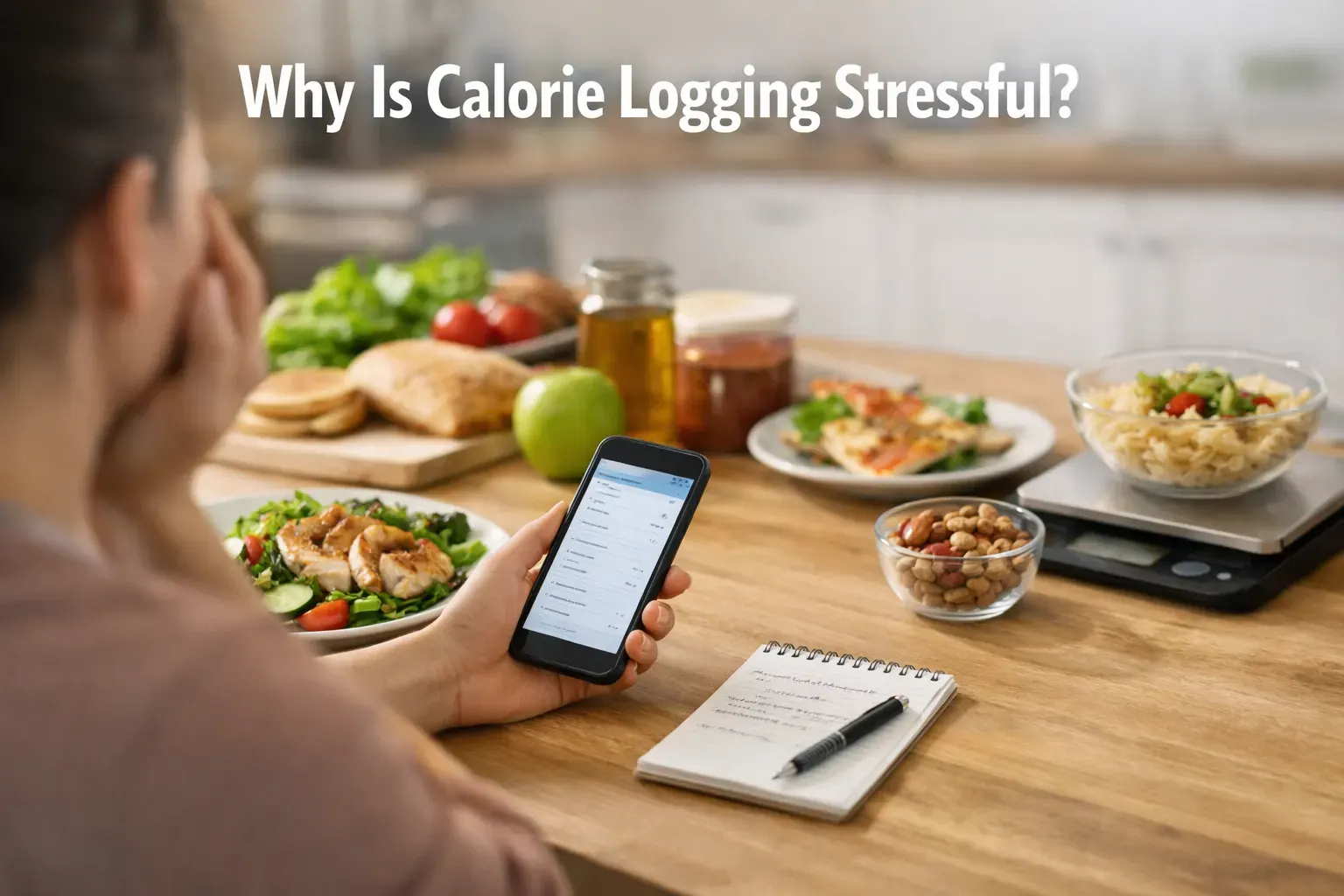
You start the day with good intentions. Breakfast is easy enough, lunch is manageable, then dinner arrives with sauces, snacks, a handful of something while cooking, and suddenly the whole thing feels like admin. If you've ever asked why is calorie logging stressful, the short answer is this: the task often asks for more precision, time and emotional energy than real life comfortably allows.
That does not mean calorie logging is bad. It means the way many people do it creates friction. When tracking feels like a daily audit instead of a useful tool, stress builds quickly. For busy people trying to lose weight or stay in control of intake, the problem is rarely motivation alone. More often, it is the gap between how people actually eat and how traditional logging expects them to record it.
Why is calorie logging stressful for so many people?
The stress usually comes from three pressures happening at once. First, there is the mental load of remembering, estimating and entering everything. Second, there is the emotional pressure of seeing every choice turned into a number. Third, there is the practical problem that food is not always neat, labelled or easy to measure.
When those pressures stack up, logging stops feeling supportive and starts feeling like homework. A sandwich from a cafe, a homemade curry, office biscuits, drinks out, leftovers from the fridge - all of these are normal parts of life, but they do not fit neatly into rigid tracking systems.
A lot of people also assume they must log perfectly for tracking to be useful. That belief creates an all-or-nothing pattern. Miss one meal, guess one portion, or forget one snack, and the day feels ruined. Once that happens a few times, people stop seeing logging as a tool for awareness and start seeing it as a test they are failing.
The real sources of stress
Too many decisions
Decision fatigue is a big part of the problem. Every meal can trigger a chain of tiny questions: What was the portion size? Which database entry is closest? Was that cooked or uncooked weight? Did I include oil? Was that one tablespoon or two?
Each question is small on its own. Across a full day, they add up. If you are already juggling work, commuting, family life and the general background noise of modern life, food logging can feel like one more task competing for attention.
Perfectionism makes the process heavier
Some users treat calorie logging like accounting down to the penny. There is a place for precision, especially if you are trying to understand why progress has stalled. But for most people, trying to be exact at every meal is exhausting.
This is where stress often comes from, not from the numbers themselves but from the pressure to get every number right. A difference of 50 calories can feel enormous in the moment, even though long-term consistency matters more than daily perfection.
Food is social, not just numerical
Eating is rarely just fuel. It happens at birthdays, work lunches, family dinners and weekends away. Logging in those moments can feel awkward or intrusive. Nobody wants to pause a meal out to dissect every ingredient while everyone else is getting on with the evening.
That social friction matters. If tracking makes you feel detached from normal life, it becomes harder to maintain. A system that works only on quiet, controlled days is not really a system you can trust.
The emotional charge of the numbers
For some people, numbers create clarity. For others, they create judgement. Going over target can feel like overspending, except with more guilt attached. That is especially true if someone has a history of strict dieting or on-off attempts to lose weight.
This does not mean calorie targets are inherently harmful. It means the framing matters. If tracking feels punitive, stress rises. If it feels like useful feedback, stress tends to drop.
Why calorie logging feels harder than it should
A lot of apps make users do too much manual work. Searching databases, comparing duplicate entries, adjusting quantities and building recipes from scratch can turn a 20-second action into a 10-minute one. That is fine for people who enjoy detail. It is not fine for someone trying to stay consistent on a normal Tuesday.
There is also a basic mismatch between intention and workflow. Most people want a simple answer to a simple question: roughly how much have I eaten, and what does that mean for the rest of the day? Instead, they get a complicated logging process that asks them to become part nutritionist, part detective.
The more steps there are, the more likely people are to delay logging. Once logging is delayed, memory gets worse. Once memory gets worse, estimates become rougher. Then confidence drops, and the whole habit starts to feel shaky.
Stress increases when tracking becomes reactive
Logging works best when it helps you make calm decisions ahead of time. It works poorly when it becomes a running clean-up operation after the fact.
If you only log once you have already eaten, the app becomes a scoreboard. If you log with some level of planning, it becomes a budget. That difference is bigger than it sounds.
People often find calorie logging stressful because they are constantly discovering the damage after the moment has passed. A pastry at 11, a meal deal at 1, crisps at 4, takeaway at 8 - then a late-night total that feels impossible. The stress is not just the intake. It is the loss of control.
This is where a budget-style model helps. Thinking in terms of available calorie credit can make decisions easier because it shifts the question from What did I do wrong? to How do I want to spend the rest of my day? That is a more practical mindset and usually a calmer one.
How to make calorie logging less stressful
Aim for consistency, not forensic detail
You do not need laboratory accuracy to get useful results. If your goal is fat loss or better portion awareness, a consistent estimate is often more valuable than a perfect log you can only maintain for three days.
Think in ranges when exact numbers are impossible. Choose the closest realistic entry and move on. The point is to stay engaged with the habit, not to create a mathematically flawless food diary.
Reduce the number of manual steps
The fastest logging method is usually the one you will actually use. Snapping meals, scanning barcodes and reusing recent foods remove friction immediately. If your system requires too much typing, it will eventually test your patience.
This is why low-friction tools matter. Features like photo recognition, barcode scanning, saved meal history and simple weekly planning do more than save time. They protect consistency by reducing the effort required to stay on track.
Plan some of your intake before you eat it
Even light planning can lower stress. You do not need to map every gram of every meal. But if breakfast and lunch are roughly accounted for earlier in the day, dinner stops feeling like a financial surprise.
A simple seven-day meal structure can be enough. It creates guardrails without making life rigid. You still have flexibility, but you are making fewer decisions under pressure.
Stop treating one imperfect entry as a failed day
One guessed meal does not invalidate your log. One takeaway does not erase a week of decent choices. Stress spikes when people treat imperfect tracking as useless tracking.
A better approach is to keep the record going. If lunch was a rough estimate, log dinner anyway. If you forgot breakfast, start from now. Continuity matters more than clean sheets.
Why a calmer system improves results
A stressful system is hard to repeat. A calmer one is easier to keep. That sounds obvious, but it is the central issue.
Weight management usually responds better to steady habits than short bursts of extreme effort. When tracking is quick, understandable and forgiving enough for real life, people tend to use it for longer. Longer use means better awareness, better decisions and more stable progress.
That is why the best tracking systems are not just accurate. They are usable. They help you see the shape of your day at a glance. They give you enough structure to stay accountable, without making every meal feel like paperwork.
For many people, Calorie Bank Credit fits this better because it frames intake like a daily spending budget rather than a moral scorecard. That shift can reduce pressure straight away. You are not trying to be perfect. You are trying to manage your credit sensibly, meal by meal.
When stress is a sign to change approach
If logging makes you more aware and more consistent, it is doing its job. If it makes you obsessive, avoidant or drained, the approach needs adjusting. That could mean using quicker tools, planning more in advance, or loosening the expectation of precision.
There is no prize for using the most complicated method. The best method is the one that helps you make better choices with the least unnecessary effort. For most people, that means fewer steps, clearer feedback and a system that works on ordinary days, not just ideal ones.
If calorie logging has felt stressful, that does not mean you are bad at it. It usually means the process has been asking too much from you. Make it faster, make it simpler, and make it something you can live with - because the habit that fits your life is the one most likely to last.