
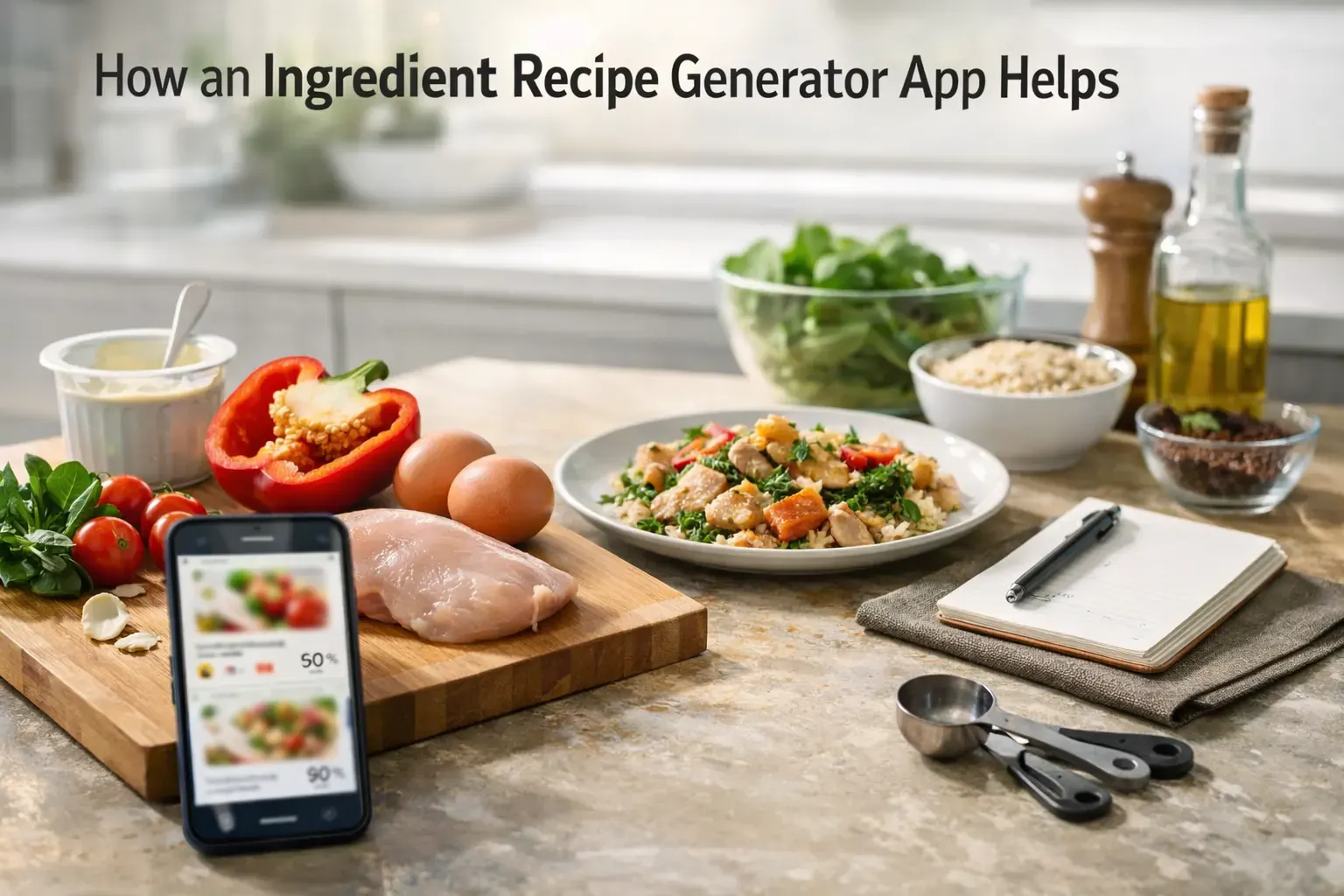
Half a pepper, two eggs, a yoghurt nearing its date, and a chicken breast you forgot to cook - that is exactly when an ingredient recipe generator app earns its place on your phone. Instead of staring into the fridge and guessing, you get a fast route to a meal that fits what you already have, what you actually want to eat, and what your calorie budget can handle.
For anyone trying to lose weight or simply keep food choices under control, that speed matters. Good intentions often fall apart in the gap between hunger and decision-making. If meal planning feels too slow and calorie counting feels too manual, an app that builds recipes from ingredients can remove friction at the exact point where people usually give up.
What an ingredient recipe generator app actually does
At its simplest, an ingredient recipe generator app takes the foods you already have and turns them into usable meal suggestions. You enter a few items, or in some apps scan and log them quickly, and the app returns recipes built around those ingredients. The better versions do more than just match foods. They also consider calories, portion sizes, cooking time, and whether the result feels realistic for a Tuesday night rather than a fantasy pantry.
That difference matters. A basic recipe finder might tell you that tomatoes, rice and chicken can become ten different meals, but that is not always helpful if half of them need ingredients you do not keep at home. A more practical app narrows the choices and gives you meals you can actually make now, with less waste and less effort.
For people managing intake, this is not just about inspiration. It is about control. When a meal idea starts with the ingredients already in your kitchen, you are less likely to order a takeaway or grab something random that blows your daily budget.
Why this works so well for calorie control
Weight management usually breaks down in ordinary moments, not dramatic ones. It is the rushed lunch between meetings, the late dinner when you cannot be bothered to think, or the snacky evening when there is "nothing in" even though the fridge is full of bits and pieces.
An ingredient recipe generator app helps because it shortens the distance between opening the fridge and eating a sensible meal. That sounds small, but it is one of the biggest advantages any nutrition app can offer. The less thinking required, the easier it is to stay consistent.
This is especially useful if you prefer a budgeting approach to calories. When food choices are framed as spending decisions, every meal becomes easier to assess. You are not asking whether a food is good or bad. You are asking whether it fits today's balance. A recipe built from ingredients you already own, with a clear calorie estimate, gives you a much better chance of staying in a sustainable deficit without feeling boxed in.
There is also a money benefit that often gets ignored. Using what is already in your kitchen reduces waste, and waste is expensive. If you regularly buy healthy food with good intentions but end up binning it, your meal planning system is not working. An app that starts from existing ingredients helps protect both your calorie budget and your grocery budget.
The best ingredient recipe generator app features to look for
Not every app in this category is equally useful. Some are clever in theory but slow in practice. If you want something that supports real daily adherence, the best features are the ones that save time and reduce decision fatigue.
Calorie visibility should be near the top of the list. If an app gives you recipe ideas but leaves you to estimate portions and energy intake yourself, you still end up doing too much manual work. Clear calorie totals, realistic serving sizes and the ability to adjust portions make a big difference.
Speed is just as important. If logging ingredients feels like admin, most people will stop using it. Features such as food photo recognition, barcode scanning and quick ingredient entry help keep the process light. The goal is to go from "what can I make?" to "I can cook this" in a minute or two, not twenty.
Meal planning matters as well. A strong app should not only generate one recipe in isolation. It should help you build a workable day or week around your goals. That is where ingredient-based recipe generation becomes more than a novelty. It becomes part of a repeatable system.
History and reporting can also help more than people expect. When you can see what you ate, when you ate it, and how it affected your weekly pattern, your decisions improve. You stop relying on memory and start working from evidence.
Where recipe generator apps help most in real life
The obvious use case is using up leftovers, but that is only one part of the value. These apps are often most helpful when life is untidy.
If you work long hours, you may not have the energy to build meals from scratch every evening. An app that turns a few ingredients into a clear dinner option can stop that familiar slide into convenience food. If you are new to calorie tracking, it can also remove the pressure of having to invent "diet meals" all the time. You use normal foods, just with more structure.
They are also useful for households with mixed priorities. One person may want higher protein meals, another may simply want something quick, and everyone wants to avoid food waste. Ingredient-led recipe suggestions create a practical middle ground.
For beginners, there is another benefit: confidence. Many people do not overeat because they know nothing about nutrition. They overeat because making the next meal feels annoying, repetitive or mentally expensive. When an app gives you a sensible option from what you already have, it reduces friction and makes consistency feel manageable.
Where an ingredient recipe generator app can fall short
There are trade-offs. An ingredient recipe generator app is useful, but it is not magic. If the ingredient data is vague, the calorie estimate may be vague too. If you enter "pasta" without quantity, brand or sauce details, the output can only be so accurate.
It also depends on your expectations. If you want chef-level recipes with perfect culinary technique, some apps will feel basic. Their job is not to impress dinner guests. Their job is to help you make workable meals quickly. For many users, that is exactly the point. But it is worth being honest about the difference.
Another limitation is food preference nuance. Good apps let you filter for goals or dislikes, but they may still suggest combinations you would never choose. That is why customisation matters. The best results come when the app learns from your habits rather than throwing random ideas at you.
And if your wider system is chaotic, recipe generation alone will not fix it. You still need a daily calorie target, a clear view of your progress, and an easy way to log what you actually eat. Recipe suggestions work best when they sit inside a broader routine, not as a standalone trick.
A smarter way to use an ingredient recipe generator app
The strongest approach is to treat the app as a decision tool rather than an entertainment feature. Open it when you need a fast answer, not endless browsing. Start with the ingredients that need using first, then choose recipes that fit your remaining calorie balance for the day.
It also helps to think in patterns. If you know you rely on quick lunches and low-effort dinners during the week, save ingredient combinations that repeat well. Chicken and veg. Eggs and spinach. Yoghurt, oats and berries. The more often your app can turn familiar staples into easy meals, the less likely you are to drift off plan.
This is where a system like Calorie Bank Credit fits naturally. When recipe generation sits alongside fast logging, barcode scans, photo-based food recognition, weekly diet planning and a visible food history, the whole process becomes more useful. You are not just finding something to cook. You are managing your intake with less admin and more clarity.
That is the real win. An ingredient recipe generator app should not make healthy eating feel like homework. It should help you use what you have, spend your calories with more intention, and keep moving even on busy, imperfect days.
If your meals often go off track because deciding what to eat feels harder than eating itself, the right app can give you back that bit of control - and sometimes that is all you need to make the next good choice.